
Talent Strategy
The nature of work has shifted dramatically. Flexible schedules and remote work have replaced the traditional 9-to-5 model. People now work at different times, in different places, and at different paces. Our systems for managing and developing talent must adapt to this new reality.
Apprenticeship systems are designed around the learner. The greatest opportunity for expanding registered apprenticeships lies with small and medium-sized businesses. Many of these employers want to participate but lack the administrative capacity, financial resources, or technical know-how to navigate the apprenticeship system. They know their trade or occupation and can train apprentices — what they need is structured support.
Apprenticeship intermediaries provide support by mentoring both employers and
apprentices as well as wrap-around services to complement the apprentice journey. Any effective workforce development strategy must focus on both sides of the equation: the employer and the learner.
Industry-driven apprenticeships, supported through industry associations, remain an underused asset. Associations already have education committees, peer-to-peer
networks, marketing capacity, and regulatory relationships that strengthen apprenticeship pathways. With appropriate financial and regulatory support, Associations play a central role in accelerating apprenticeship growth, including acting as group sponsors.
Financial supports could include grants for curriculum development, wraparound services for apprentices, marketing initiatives, and funding to administer wage subsidies or tool
supports. Wage subsidies ease onboarding and encourage employers to hire new
apprentices. Tool allowances and OSHA-related training support address common barriers for small employers. Group sponsorship also increases flexibility in the apprentice journey, especially when individual employers cannot provide the full scope of practice.
Retention remains a critical challenge. Losing an employee typically costs at least half of that employees annual salary — and often up to twice that amount — not including the cultural and productivity impacts. Turnover strains existing staff, disrupts customer
service, and reduces the effectiveness of trainers who must divert time from their own work.
Every worker brings three core attributes: talent, skills, and knowledge. Yet hiring practices often prioritize them in the wrong order, focusing first on knowledge and experience.
High-performing organizations reverse this logic: they hire for talent and potential, then develop the skills and experience needed for long-term success.
Industry associations play a central role in building modern talent pipelines by leveraging a digital portal strategy. A sector-wide portal would house labour-market information, worker profiles, and verified skills and experience. Employers could access this shared talent
pipeline directly, improving recruitment efficiencies and visibility across the sector.
Employer size must be considered when designing industry-specific strategies. Large
employers and small/medium employers face different operational realities. Smaller firms typically require more external support to participate effectively in apprenticeship systems.
Peer-to-peer mentoring has proven successful across multiple sectors, enabling
experienced employers to guide newer or smaller firms toward desired outcomes. Large employers, despite having more resources, often lack apprenticeship experience and would also benefit from mentoring and association-based supports.
Industries should expand the use of group sponsorship models to increase apprenticeship spaces and provide broader training exposure for employers that do not cover the full
scope of a trade or occupation. This is where apprenticeship intermediaries become essential — coordinating placements, supporting employers, and ensuring apprentices receive complete training.
Industry also helps remove barriers to both entry and completion. Retention strategies are critical: many organizations do not measure the financial impact of turnover, nor do they
address underemployment caused by external constraints such as childcare. As work patterns move further away from the traditional Monday–Friday, 9–5 model, childcare solutions must adapt. Flexible hours, flexible days, and — for larger employers — on-site childcare strengthen retention. Childcare models must also accommodate seasonal
industries, such as construction, where hours vary significantly throughout the year. Regulators need to modernize childcare rules to support these realities, including solutions for younger school-age children who finish school before their parents’ workday ends.
Government regulators must work with industry to maintain oversight while enabling growth. With rising retirements and increasing pressure to retain talent, regulators should provide flexibility in skills recognition — including foreign credential recognition and
equivalency across training programs where skills overlap. For example, in the skilled trades, if a specific skill is already demonstrated in one trade, it should not need to be repeated simply to satisfy another trade with identical requirements.
The global skills gap has been documented for years, but the scale of the problem has now outgrown the term itself. This is no longer a “skills gap” — it is a skills canyon, and it
threatens to erode economic growth, productivity, and competitiveness worldwide. Trillions of dollars in potential output are at risk.
This raises an obvious question: How can such a canyon exist at a time when training tools have never been more advanced? Artificial intelligence, machine learning, immersive learning platforms, and a wide range of in-person, virtual, and interactive training models should be narrowing the divide, not widening it. These innovations should be pouring gold into the canyon.
Yet the shortfall persists — and grows. The explanation lies not in the absence of training technologies, but in how unevenly they are accessed, adopted, and aligned with real
labour-market needs.
Without ever having met you, I can say with confidence that you and your
great-great-grandfather took tests the same way: multiple choice, true/false, long answer. At best, the questions have become slightly more sophisticated or moved onto a screen.
But in a world of blended learning, adaptive technologies, and diverse learning speeds and styles, why are we still relying on static, monolithic tests? These methods do not measure skills. And if candidates are never given a meaningful chance to demonstrate their abilities, it should come as no surprise that the skills canyon is as vast as it is.
In most job-related training programs, the final assessment is still the traditional test.
Multiple choice, true/false, and the occasional long answer remain popular because they are easy to administer. But they reveal little more than a person’s ability to memorise information under time pressure. This is not a skills assessment — it barely qualifies as a knowledge assessment.
The real problem is the disconnect between what we call “successful training” and what we call “successful skills development.” Training methods have evolved, but assessment methods have barely changed. Innovation has been limited to more elaborate questions and an endless series of surveys.
The outcome is predictable: we are producing workers who excel at clicking circle-shaped buttons, not workers whose skills match the needs of modern employers.
Despite overwhelming evidence that people learn, and demonstrate learning in different ways, we continue to assess competency and skills in the same traditional manner. We have modernized training through dynamic, blended-learning models, yet assessment remains static. Pairing innovative learning with outdated testing has failed — it creates
barriers, limits achievement, and undermines genuine skills development. We prioritise the administrative convenience of standardized tests at the expense of meaningful evaluation.
If a candidate struggles with American English, is a newcomer, lives with dyslexia or
another neurodivergence, or is simply a poor test-taker, years of training can be reduced to a single high-stakes exam — one they were never positioned to succeed in.
A paradigm shift is needed.
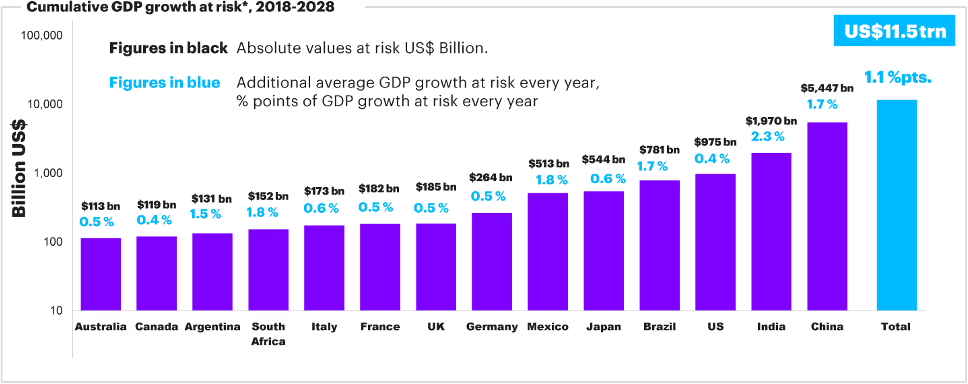
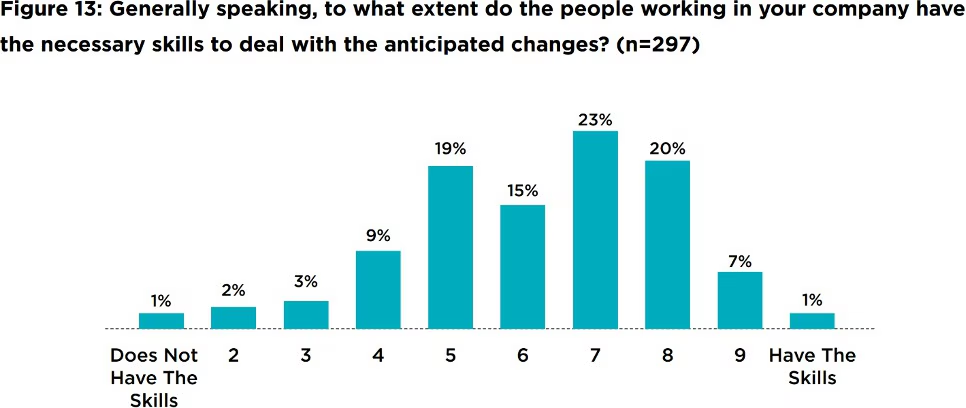
In a 2020 report, Accenture revealed that G20 countries risk forgoing up to $11.5 trillion in GDP growth over the next 10 years if they are unable to adapt the supply of skills to meet the needs of the new technological era. In the same year, McKinsey revealed that nearly 9 out of 10 executives surveyed are imminently facing skills gaps, and in 2021 the Future
Skills Centre in Canada in partnership with Ryerson University and Microsoft expounded that only 1% of nearly 300 Canadian executives surveyed confidently believed that their new hires and recruits had the skills to perform the jobs for which they were hired.
|
Loss in GDP growth if countries are unable to adapt supply of skills to meet needs of the new technological era. Image: Accenture
But these skills challenges are not limited to technological “skills of the future”. This problem is pervasive across society and the entire economy:
In its 2020 “Jobs of Tomorrow” report, the World Economic Forum surmised that 40% of all new jobs in the next three years would be in the care sector. The COVID-19 pandemic
unveiled scandals and criticisms that have made commonplace words like negligence and malpractice in describing long-term care homes. A greater, competence-based skills framework could have been effective in this regard.
In Canada, 42% of the workforce has literacy skills below those needed to be fully effective for the position they hold. Notwithstanding the “hard skills” gap, the soft skills gap is paralysing economies. What’s most astounding is that a mere 1% gain in literacy abilities could lead to a 5% gain in productivity, worth the equivalent of $54 billion a year in Canada, alone.
In the US, it is estimated that $39 Billion in wages – and $10 Billion in income tax revenue – is lost every year due to college-educated immigrants being mired in low-skilled jobs or
unemployment lines. In Canada, more than half of all full-time taxi and ride-share drivers are immigrants, of which a majority hold degrees and advanced skills-based diplomas that render them overqualified for their driving jobs.
Every year, hundreds of thousands of military personnel require skills training to reintegrate into the workforce. VALID-8, a patented platform leveraging video assessments, was used with the British Army in over 130 countries to assess transferrable skills of military personnel reintegrating into the economy, giving members of the military a greater opportunity to effectively compete for civilian jobs.
|
Supporting Entrepreneurship and SME’s: A Post-Pandemic Skills and Training Agenda Image: Future Skills Centre, Ryerson University Diversity Institute
In 2020, Vametric and its partners worked with Utah legislators to pass reforms removing hours-based requirements and traditional exams as the primary thresholds for
advancement in apprenticeship programs. Instead, Utah will evaluate progression through demonstrated mastery. This shift toward assessing actual ability and competence is a meaningful step forward.
The economy needs assessment systems that validate achievement and real-world capability. Continuing to rely exclusively on traditional testing only reinforces a broken model — one that perpetuates race, gender, language, and ableist inequities that modern economies cannot afford to sustain.
A fully integrated digital portal would give users, regulators, and governments the ability to monitor, grow, and strengthen a modern apprenticeship system. This all-access platform could include national, state, and local labour-market information; predictive human-analytics tools for jobseekers and students exploring apprenticeship pathways; and “day-in-the-life” videos to help prospective apprentices understand the realities of
each occupation.
A digital logbook — with third-party verification and optional regulatory approval — would allow apprentices to demonstrate skills using a show it, prove it, defend it model. This structure supports micro-credentials, continuing-education tracking, and credit
recognition. It also enables industry to build a national, sector-based skills registry capable of mobilizing the workforce quickly when major projects move into operation.
The portal can be secured using current authentication technologies and user-verification protocols, ensuring integrity, privacy, and trust across the system.
Employers must be accountable for the progress of their apprentices. One of the most effective mechanisms to ensure apprentices advance through their training pathway is the use of employer tax credits tied to measurable milestones. Government and
apprenticeship regulators can define both the milestones and the value of the credit.
Tax credits are far more accessible than grants for small and medium-sized employers. Many lack the administrative capacity to navigate grant applications, but nearly all rely on accounting firms to manage their tax filings. Embedding apprenticeship incentives directly into the tax system removes administrative barriers and expands participation. For
accountants, applying a tax credit is a simple ledger adjustment — a fraction of the effort required to complete grant paperwork.
A milestone-based tax credit also reinforces accountability. Employers who actively move apprentices through their training receive the credit; those who do not are ineligible. This ensures public funds support successful training outcomes rather than subsidizing stagnation.
The proposed digital platform includes a progress-tracking feature that shows how far an apprentice has advanced relative to the training standard. This data can be linked to
individual employer sponsors, providing a transparent view of training quality and
apprentice progression. It also gives regulators a reliable, real-time mechanism to validate eligibility for tax credits and monitor overall system performance.
The registered apprenticeship model must allow flexibility in how competence is
demonstrated. Apprentices should be able to provide different forms of evidence to show they have mastered a skill. This evidence can be uploaded into a digital logbook, verified by a third party, and, where required, confirmed by the regulator.
Modern identity-verification technologies can ensure that the individual submitting the evidence is the rightful owner of the profile, maintaining integrity and trust across the system.
Governments invest in education in many forms, but apprenticeship must be viewed as an education system — not simply a job program. When evaluating where to invest,
apprenticeship stands out as one of the few post-secondary pathways that delivers a return on investment almost immediately.
A typical apprenticeship begins generating returns for government within months through
income-tax contributions, even while the apprentice is still learning. By contrast, traditional post-secondary programs often take years before any direct return on that investment is
realized.
The Administration can accelerate progress in registered apprenticeships by focusing on three core actions:
ABOUT THE AUTHOR
WILDERFORCE is an organization with extensive experience in developing, scaling and recruiting participants in an apprenticeship system. Experience comes from the employer/sponsor, apprentice, regulatory bodies and researchers. The model includes all aspects of the apprentice pathway to exponentially increase the number of apprentice training spaces and thereby increase the number of apprentices. WILDERFORCE uses a combination of traditional methods and technology to achieve desired outcomes.
If you have an interest in learning more about how Wilderforce could be a complementary service to your organization, contact us at information@wilderforce.com to set up a time to discuss.